The cooling fault was found and put right, and the unit has been steady since. What annoyed me was the wait for the part, which nobody flagged when the visit was booked. Sound work, slow supply.
Greta P.2026-02-11
Independent Viking service · St. Johns County, Florida
$80 diagnostic, credited to the repair
coastal
Salt aerosol is hygroscopic, so metal near the water spends more hours wet than the weather record suggests. The failures that follow are specific and repeatable.
Reviewed 2026-08-08
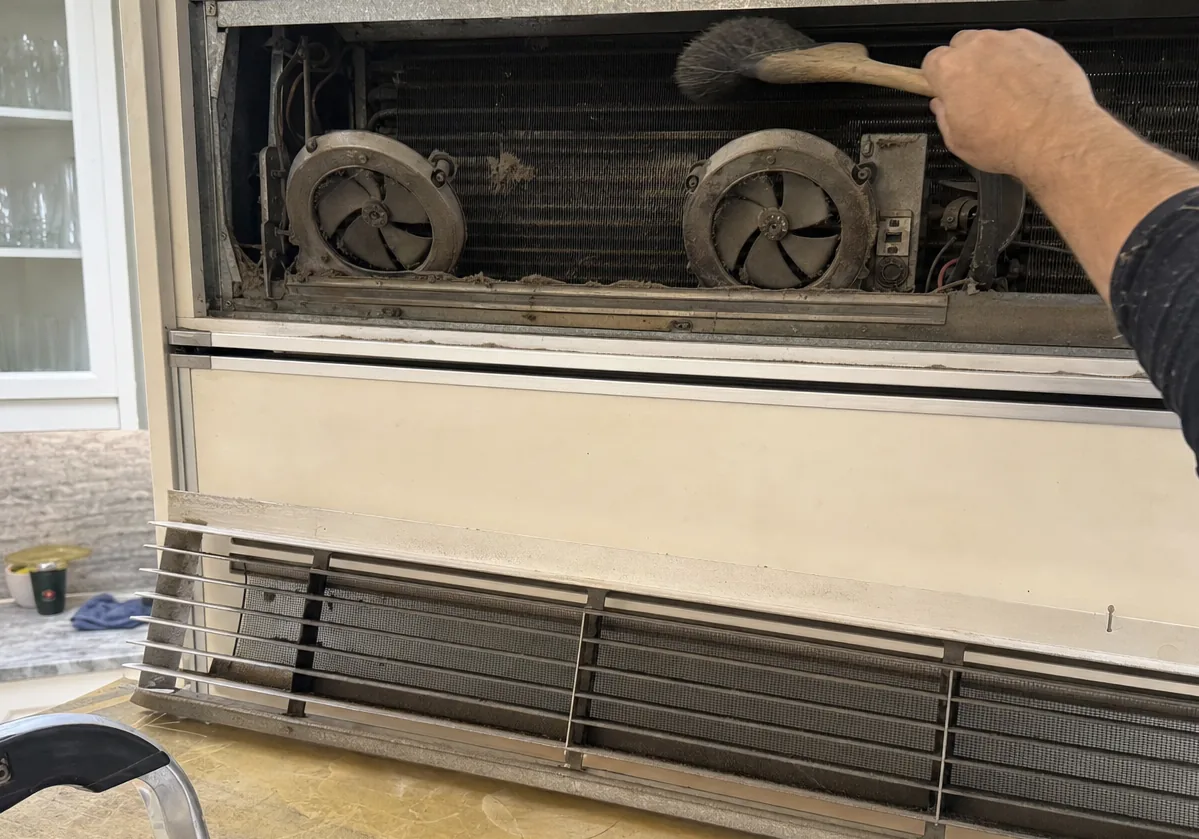
Coastal corrosion is usually explained as rust, which undersells it. The mechanism that matters indoors is not rain and it is not spray. It is a thin film of salt that lands on a surface, stays there, and then pulls moisture out of humid air for hours after the surface looks and feels dry.
That single property — hygroscopy — is why an appliance three streets back from the water corrodes on a schedule that surprises its owner. The metal is wet far more often than the weather record implies, and it is wet with a chloride solution rather than with water.
| Component | Failure | First symptom |
|---|---|---|
| Refrigerator condenser fin pack | Aluminium corrodes, fins pack with residue | Longer run times, higher bills, no temperature complaint yet |
| Condenser fan motor | Bearing loads, shaft corrodes | Intermittent noise, then a warm cabinet |
| Hood backdraft damper | Pivots gum with salt film and grease | Weak extraction, or cold outside air falling in |
| Remote or roof-mounted blower | Wheel corrodes and unbalances | Vibration through the cabinetry |
| Grill electrode insulator | Cracks, spark tracks to ground | Clicking with no light |
| Stainless fasteners in aluminium | Galvanic seizure | Screw heads shear on removal |
The condenser is first on that list for a reason. It is the part that has to reject heat, it is the part nobody can see, and it degrades without making a noise. By the time a coastal refrigerator is losing temperature, the coil has usually been half-blind for a year.
Stainless screws into aluminium panels is an ordinary appliance construction choice and a poor one within a mile of open water. The two metals sit apart on the galvanic series, the salt film supplies the electrolyte, and the joint corrodes from the inside. The result is a fastener that will not turn and then shears, which is why service calls in 32080 and 32084 need to be scheduled with drilling and retapping in the plan rather than as a surprise.
We carry extraction tooling to coastal calls as standard. It is the single biggest difference between a one-visit repair and a return trip.
Three things, and none of them requires buying anything:
Coating a condenser with anything sold as a protectant reduces its ability to reject heat, which is the one job it has. Spraying penetrating oil into a hood damper collects grease and gums it faster. And replacing a corroded part without addressing the exposure just resets the clock — which is fine if you know that is what you are buying, and frustrating if nobody told you.
We photograph the condition before we quote, so you can see the fin pack rather than take our word for it. Where the exposure is the real cause, the estimate says so and gives a realistic expectation for how long the replacement part will last in the same position. That is more useful than a warranty argument two summers from now.
Applies to Relevant areas
A band, not a single number: the firm figure is written down after the appliance has been opened and measured, and a range is what you can act on before that. Parts and labour together, fitted, for the fault described here.
| Repair | Typical range |
|---|---|
| Diagnostic visit | $80 flat |
| Refrigeration fan or defrost system | $240–$640 |
| Compressor or sealed-system repair | $970–$2,640 |
| Control board or touch panel | $410–$980 |
Flat $80 diagnostic covering the visit and the full diagnostic sequence, credited toward the repair once you approve the work.A written estimate comes before any part is ordered or any labour is billed. The whole published table.
The visit is a flat $80 diagnostic, credited toward the repair once you approve it. The repair itself lands in the bands published on this page — refrigeration fan or defrost system $240–$640; compressor or sealed-system repair $970–$2,640; control board or touch panel $410–$980 — so $80 to $2,640 covers the work described here, parts and labour together. The firm number is written down after the appliance has been measured, never before.
Flat $80 diagnostic, credited toward the repair when you approve the work. If you decide not to go ahead, the diagnostic stands on its own and you keep the written estimate, including what was measured and what was ruled out.
90 days on our labour and 365 days on the parts we supply. Genuine OEM parts. A return visit on the same fault inside the term carries no second diagnostic and no trip charge.
Ring the bench and describe the symptom. A question that cannot be answered on the telephone is a question that needs a meter on the appliance, and we would rather say so than sell a visit to find out.
The cooling fault was found and put right, and the unit has been steady since. What annoyed me was the wait for the part, which nobody flagged when the visit was booked. Sound work, slow supply.
Greta P.2026-02-11
Our refrigerator door stopped sitting square and the gasket was pulling in humid air at the top corner. He reset the hinge cartridge, fitted a new gasket, then ran a paper test right round the door before he called it finished.
Colin B.2026-01-27
Freezer frosted along one side and the shelves stuck fast. He checked the seal with a slip of paper, found one corner letting air in, and refitted the gasket so it closes evenly across the whole face.
Owen K.2026-04-02
Flat $80 diagnostic, credited toward the repair when you approve the work. A written estimate comes before any part is ordered or any labour is billed.
90 days on labour, 365 days on parts, genuine OEM parts only. Calls placed after hours are returned the next working morning.