The range works again after a new igniter, so the repair itself was sound enough. What I did not care for was how little got explained while it was going on. I had to ask twice what had actually failed and why it mattered.
Kathy V.2025-12-05
Independent Viking service · St. Johns County, Florida
$80 diagnostic, credited to the repair
installation
Clearance, level, gas supply and ventilation in St. Augustine's oldest housing stock, and how an installation compromise turns into a repeat repair.
Reviewed 2026-08-11
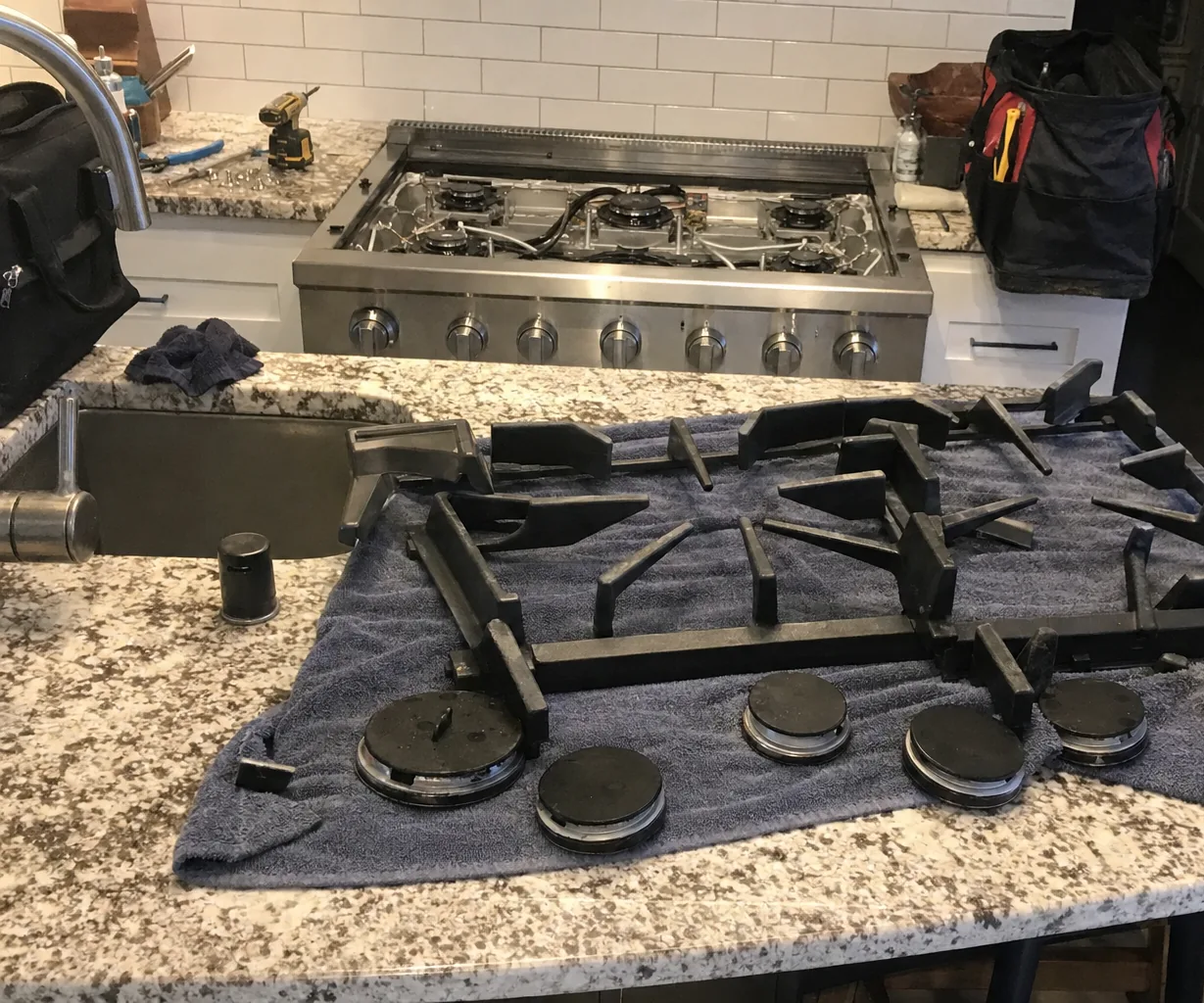
A professional range asks for more space, more air and more gas than the kitchen it usually ends up in. In the oldest parts of St. Augustine — the downtown blocks and the 1920s and 1930s houses across the Bridge of Lions in Davis Shores — the original kitchen was drawn for a stove and an icebox, and every professional range in those houses sits in an opening that has been altered.
Most of those alterations are fine. The ones that are not tend to produce service calls three to eight years later, and by then nobody connects the fault to the installation.
| Measurement | Why it matters | What goes wrong |
|---|---|---|
| Rear and side clearance | The appliance cools its own controls with that air | Controls run hot, boards and switches fail early |
| Cabinet opening width and depth | The range must sit in the plane of the run | Forced fit, twisted chassis, doors out of square |
| Level, front to back and side to side | Oven racks, door seal, burner performance | Uneven bake, door will not seal, drawer drops |
| Gas supply and line size | Full rate on all burners plus the oven | Low flame when everything is on at once |
We take all four on any first visit to a range in the historic stock, because three of the four common complaints in those houses trace back to one of them.
Installation instructions specify clearance to combustible surfaces and a minimum gap behind the appliance. Both exist for the same reason: the range needs to move air past itself, and the surrounding cabinetry needs to stay below its own limits. In a house where the opening was cut into an existing run, that gap is often the first thing given up — the range is pushed back until it looks flush with the cabinet fronts, and the specified air path disappears.
The appliance does not fail immediately. It fails slowly, in the control pocket, where a few extra degrees over thousands of hours shortens the life of switches, igniter modules and boards. The tell is a range that has had two or three electrical faults in different places over a short period while the burners and the oven cavity are mechanically perfect.
An oven that is out of level front to back bakes unevenly no matter how accurate its thermostat is, because convection inside the cavity is a buoyancy effect and buoyancy follows gravity. A range out of level side to side will not seal its door along the full gasket, and the same appliance will read correctly on a probe in the centre of the cavity while browning one side and not the other.
In houses this old, the floor is frequently the culprit rather than the appliance’s feet, and heart pine over a century of settlement is not flat. We shim to the appliance’s own specification and record what we did.
Retrofitted hoods in the historic stock rarely get a short, straight duct. The run goes up, turns, sometimes changes section between joists, and finishes at a cap that was chosen for the roof rather than for the blower. Each of those subtracts from delivered airflow, and the owner experiences it as a hood that is not strong enough.
Before quoting a blower we check the filters, the damper and the duct, and where the duct is the answer we say so with the measurements attached. Replacing a hood into an unchanged duct does not change the result.
A professional range at full rate — all surface burners plus the oven — draws more than a small older supply line was ever sized for. The signature is that everything works individually and the flame drops when the whole appliance is in use, which owners often describe as the range having got weaker with age. That is a pipe question, not an appliance question, and it needs a licensed gas fitter rather than a parts order.
When the finding is the installation rather than the appliance, the estimate says so, with the measured numbers and photographs. That is less satisfying than a part, and it is the only version that stops the fault coming back.
Applies to Relevant areas
A band, not a single number: the firm figure is written down after the appliance has been opened and measured, and a range is what you can act on before that. Parts and labour together, fitted, for the fault described here.
| Repair | Typical range |
|---|---|
| Diagnostic visit | $80 flat |
| Igniter or burner assembly | $210–$560 |
| Control board or touch panel | $410–$980 |
| Oven thermostat or heating element | $180–$610 |
Flat $80 diagnostic covering the visit and the full diagnostic sequence, credited toward the repair once you approve the work.A written estimate comes before any part is ordered or any labour is billed. The whole published table.
The visit is a flat $80 diagnostic, credited toward the repair once you approve it. The repair itself lands in the bands published on this page — igniter or burner assembly $210–$560; control board or touch panel $410–$980; oven thermostat or heating element $180–$610 — so $80 to $980 covers the work described here, parts and labour together. The firm number is written down after the appliance has been measured, never before.
Flat $80 diagnostic, credited toward the repair when you approve the work. If you decide not to go ahead, the diagnostic stands on its own and you keep the written estimate, including what was measured and what was ruled out.
90 days on our labour and 365 days on the parts we supply. Genuine OEM parts. A return visit on the same fault inside the term carries no second diagnostic and no trip charge.
Ring the bench and describe the symptom. A question that cannot be answered on the telephone is a question that needs a meter on the appliance, and we would rather say so than sell a visit to find out.
The range works again after a new igniter, so the repair itself was sound enough. What I did not care for was how little got explained while it was going on. I had to ask twice what had actually failed and why it mattered.
Kathy V.2025-12-05
The oven in our range ran well under the dial and cakes came out pale. He logged temperature across three full cycles, found the sensor drifting, changed it and reran the log so I could see for myself that the swing had settled.
Brendan O.2026-05-26
The oven door on the range sagged and heat spilled out of the top corner. He changed both hinges and the seal, then checked the door for square with a gauge instead of judging it by eye.
Emeka B.2026-02-26
Flat $80 diagnostic, credited toward the repair when you approve the work. A written estimate comes before any part is ordered or any labour is billed.
90 days on labour, 365 days on parts, genuine OEM parts only. Calls placed after hours are returned the next working morning.